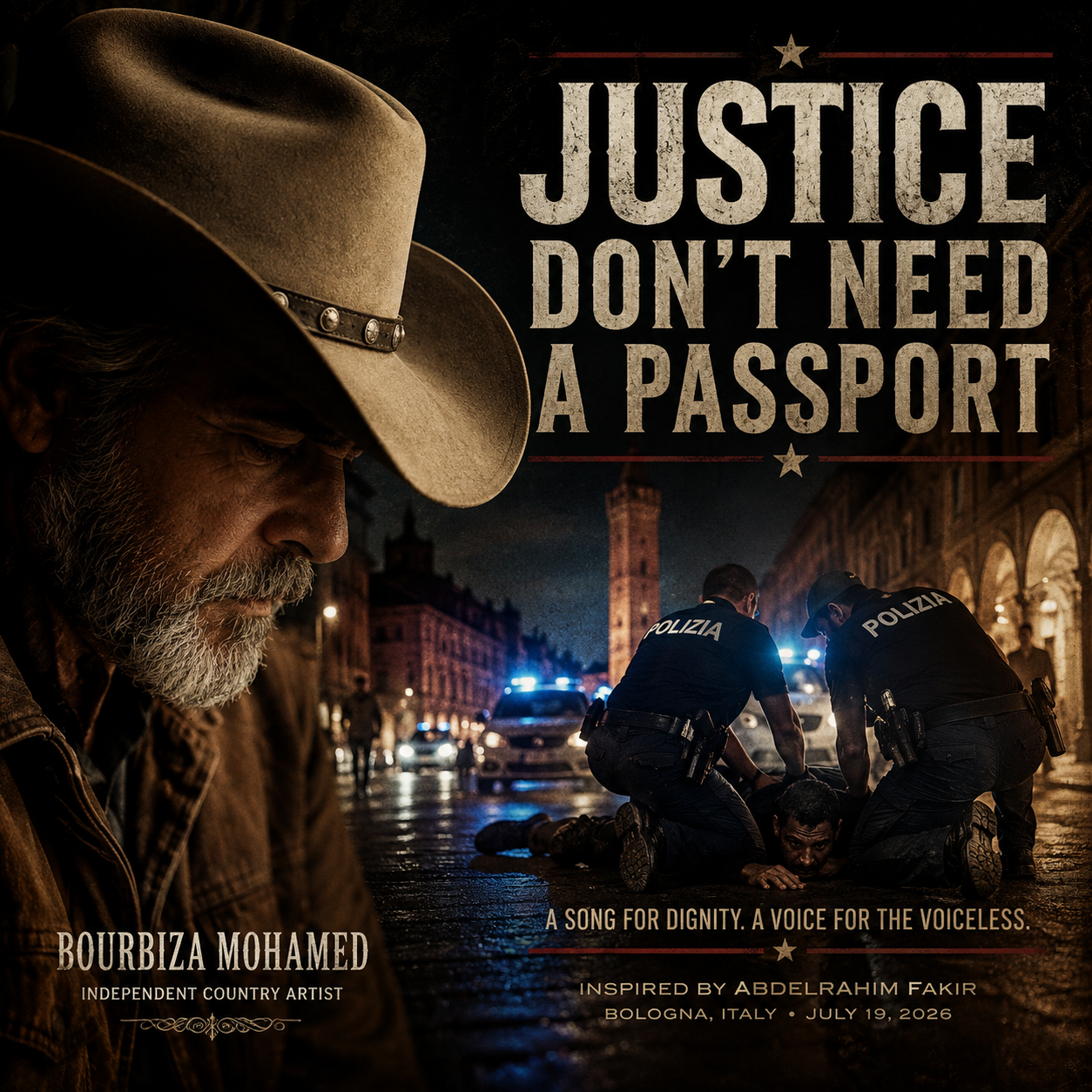
Official single · Bourbiza Mohamed · BM Country Music · 25 July 2026
Justice Don’t Need a Passport — Official Video
About the Song
“Justice Don’t Need a Passport” is the official country single by Bourbiza Mohamed, the recording name of Mohamed Bourbiza. Released by BM Country Music on 25 July 2026, the song uses the direct language of country storytelling to ask a universal question: should a person’s origin, nationality or name ever influence the dignity, mercy and equal treatment they receive?
The track is an artistic work inspired by a reported news case involving Abderrahim Fakir in Bologna. It does not claim to determine criminal responsibility, replace an official investigation or anticipate the findings of a court. Instead, it turns public questions surrounding a human tragedy into a reflective song about equality, accountability and the value of every life. The lyrics deliberately leave room for the judicial process, stating that courts may establish what happened and why.
Meaning of Justice Don’t Need a Passport
The title carries the song’s central idea in a single memorable line. Justice is not a privilege attached to citizenship documents, birthplace, social status or a familiar surname. In the chorus, the passport becomes a symbol of the borders people create between one another, while mercy represents the immediate recognition of shared humanity. The repeated phrase “someone’s son” brings the message out of abstraction and into the language of family, loss and personal responsibility.
The song does not attack an entire profession. One of its most important verses expressly distinguishes the questions raised about a specific moment from the service of officers who act with honor. That distinction is essential to the composition. The badge is presented as a symbol capable of carrying both authority and duty; because it can stand for what is right, the people entrusted with it must also be accountable to truth, evidence and the law.
A Human Question, Not a Judicial Verdict
Throughout the narrative, Bourbiza Mohamed uses questions rather than declarations of guilt. The lyrics ask whether a foreign name could affect the mercy shown to a person and whether the response might have been different if the man had looked or sounded like a member of one’s own family. These are moral and artistic questions. They are not findings of fact, and the song does not assert any legally unproven motive or offence.
This careful framing gives the single its emotional force. Listeners are invited to examine instinct, prejudice and empathy without being told to ignore due process. The lyric “Maybe courts will tell us why” explicitly recognizes that facts and legal responsibility must be established through competent authorities. Music operates here as a space for remembrance and civic reflection, while justice remains the work of evidence, institutions and the rule of law.
Country Style and Musical Interpretation
Musically, “Justice Don’t Need a Passport” is built around the storytelling traditions of country music. A low acoustic guitar opens the track, creating a restrained and intimate atmosphere. Distant pedal steel adds a mournful horizon around the vocal, while the deep male delivery begins almost as spoken testimony. The arrangement gives the words space and avoids distracting from the song’s central human question.
The pedal steel functions like a second voice, answering the singer between sections and extending the emotion beyond the words. During the bridge, the production falls back to acoustic guitar and low vocal. That reduction in instrumentation makes the direct address feel personal: the listener is asked to imagine a father, brother or family name in the same position. After a deliberate silence, the full band enters gradually for the final chorus, turning private reflection into a wider call for equal justice.
The dynamic arc is classic narrative country craft. The verses establish a person and a place; the pre-chorus examines the meaning of public duty; the chorus delivers the universal statement; and the bridge removes distance between the subject and the audience. The closing voice returns alone, naming Abderrahim Fakir as a man rather than reducing him to a label. The fading pedal steel leaves the question unresolved, inviting the listener to carry it beyond the song.
Lyrics
The complete official lyrics are reproduced below exactly as supplied.
[Intro]
[Low acoustic guitar, distant pedal steel]
[Deep male voice, intimate, almost spoken]

His name was Abderrahim Fakir...
Before the sirens,
before the headlines,
before that street in Bologna...
he was a man.

[Verse 1]
He came from somewhere far away,
But called these streets his home,
Worked his days like other men,
With dreams that were his own.
No famous name, no fortune,
No power on his side,
Just another man beneath the sun,
Trying to live his life.

[Verse 2]
Then came that day in Bologna,
Blue lights against the stone,
Two officers held him to the ground,
While fear was in his voice.
And somewhere in those desperate moments,
A question still remains:
Would you have seen another man
If he'd had an Italian name?

[Pre-Chorus]
A badge can carry honor,
A badge can stand for right,
But the hands of those who wear it
Must answer to the light.

[Chorus]
Justice don't need a passport,
Mercy don't ask where you're from,
When a man is down and crying,
You don't forget he's someone's son.
No border makes him lesser,
No foreign name makes him small,
Justice don't need a passport...
Justice belongs to us all.

[Instrumental]
[Pedal steel answers the vocal]

[Verse 3]
This song ain't for every officer,
And it ain't against the blue,
There are men and women wearing it
Who serve with honor too.
This song is for that moment,
For the two who held him there,
And asks if being foreign
Changed the mercy they could spare.

[Verse 4]
Maybe truth will come tomorrow,
Maybe courts will tell us why,
But no uniform should change the worth
Of the man before your eyes.
If prejudice was in that moment,
Let the whole world call its name,
For a stranger's life is not worth less,
And dignity's the same.

[Pre-Chorus]
A badge can carry honor,
A badge can stand for right,
But justice means accountability
When something isn't right.

[Chorus]
Justice don't need a passport,
Mercy don't ask where you're from,
When a man is down and crying,
You don't forget he's someone's son.
No border makes him lesser,
No foreign name makes him small,
Justice don't need a passport...
Justice belongs to us all.

[Bridge]
[Music drops to acoustic guitar and low vocal]

Don't tell me where he was born.
Tell me he was human.

Don't tell me which flag he knew.
Tell me what you'd do...

If the man beneath those hands
Had your father's face,
Your brother's voice,
Your family name...

Would mercy have come sooner?
Would anything have changed?

[Silence]

[Final Chorus]
[Full band enters slowly]

Justice don't need a passport,
And mercy has no race,
No man should lose his dignity
Because he's from another place.
For every honest badge out there,
Let honor hear this call:
Protect the weak, defend the truth,
Let equal justice fall.

Justice don't need a passport,
No foreign name makes a man small.
From Bologna let the question ring...

Does justice belong to all?

[Outro]
[Almost spoken, voice alone]

His name was Abderrahim Fakir.

Not "the foreigner."
Not "the immigrant."

A man.

[Pedal steel fades]
Story Behind the Song
Bourbiza Mohamed’s work as a journalist, documentary filmmaker and songwriter is grounded in observing lives across borders. “Justice Don’t Need a Passport” brings those disciplines together. Its perspective is not that of a courtroom judgment but of a storyteller asking what society owes a human being at a moment of vulnerability. The song remembers a name, resists dehumanizing labels and places dignity at the center of the narrative.
The inspiration from a news event is handled as artistic commentary. The composition asks listeners to remain attentive to facts, lawful investigation and the presumption that responsibility must be determined through due process. At the same time, it argues that empathy does not need to wait for nationality to be checked. Whatever a later legal assessment may establish, the principle expressed by the song is universal: human worth is not conditional on a passport.
About Bourbiza Mohamed
Bourbiza Mohamed is the artist name of Mohamed Bourbiza, an international journalist, documentary filmmaker, songwriter and music producer. His catalogue combines country music with elements of soul, blues and other global influences shaped by years of travel and field storytelling. He is the founder of BM Country Music, the independent label releasing “Justice Don’t Need a Passport.”
Explore the official Bourbiza Mohamed artist page, read his professional biography, or discover BM Country Music. These pages provide additional context on the artist’s recording work, journalism and independent music projects.
Listen Everywhere
Watch the official video now and follow Bourbiza Mohamed on the major music platforms. Individual release links can be updated as each service completes its catalogue indexing.
Related Songs
- Explore the Bourbiza Mohamed discography
- Listen to Justice Don't Need a Passport on Spotify
- Visit the official Bourbiza Mohamed YouTube channel
Frequently Asked Questions
Who sings Justice Don’t Need a Passport?
“Justice Don’t Need a Passport” is an official single by Bourbiza Mohamed, the artist name of Mohamed Bourbiza.
When was Justice Don’t Need a Passport released?
The official release date is 25 July 2026 through BM Country Music.
What genre is the song?
The song is country music, led by acoustic guitar, pedal steel and a deep narrative vocal.
Is the song a statement of criminal responsibility?
No. It is an artistic work inspired by a news case. It raises moral and social questions but does not determine legal facts, assign criminal responsibility or replace the work of investigators and courts.
Where can I watch the official video?
The official video is embedded on this page and is also available on YouTube.
Listen to Justice Don’t Need a Passport
Watch, listen and share the official release through Bourbiza Mohamed’s verified music channels. Follow the artist for new country singles, videos and stories from BM Country Music.